TCF Canada · TCF Québec
The French that opens Canada.
Real past papers, corrections that explain rather than just mark, and a tutor who answers your questions in French. Start without paying and without a card.
- 4 178
- past-paper questions
- 1 016
- written-expression topics
- 97 000
- words in the dictionary
YOUR NEXT CHAPTER, IN YOUR POCKET
Less wondering how.
More speaking French.
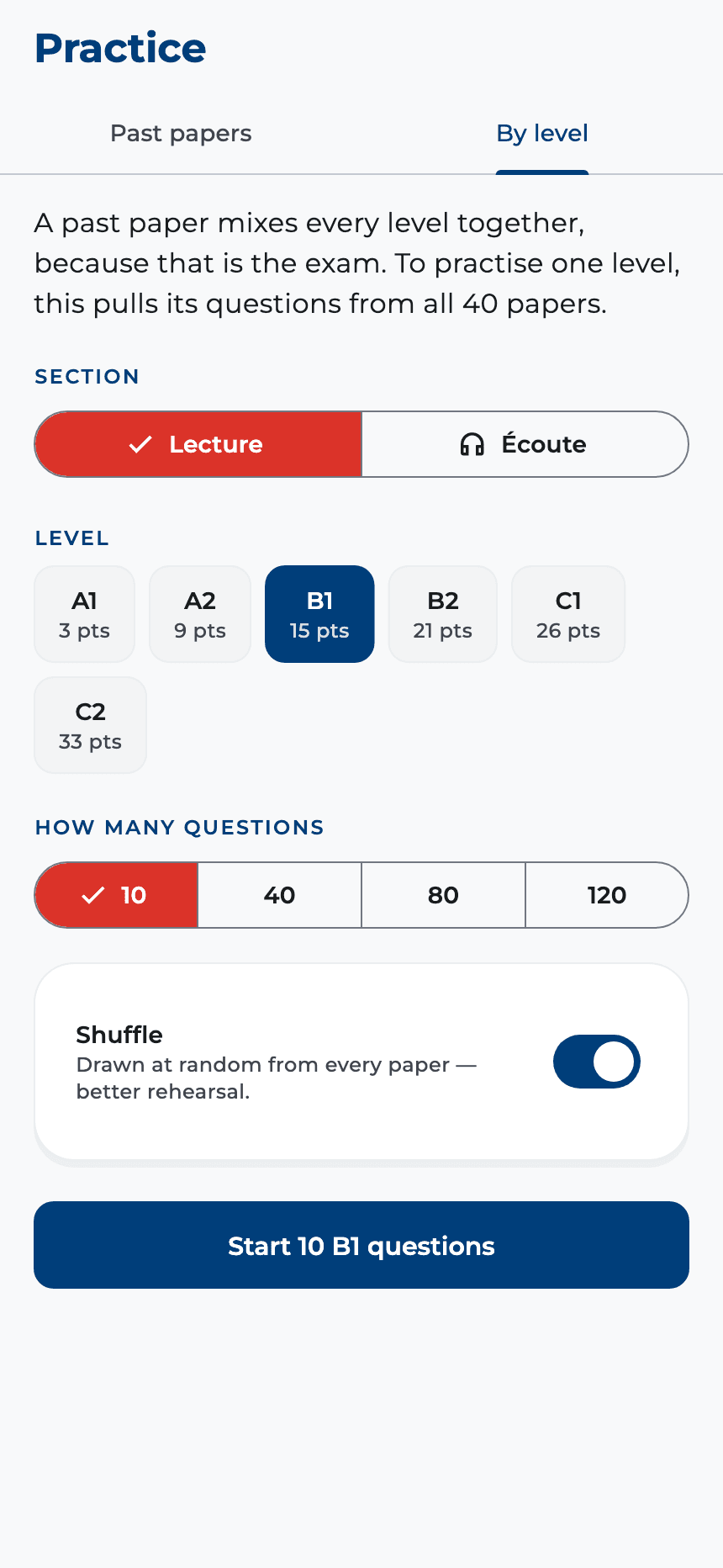
Your practice, your pace. Explore past papers or focus on a level, and make your next session count.
Explore every test. The first two answers in each test are free; unlock more with premium.
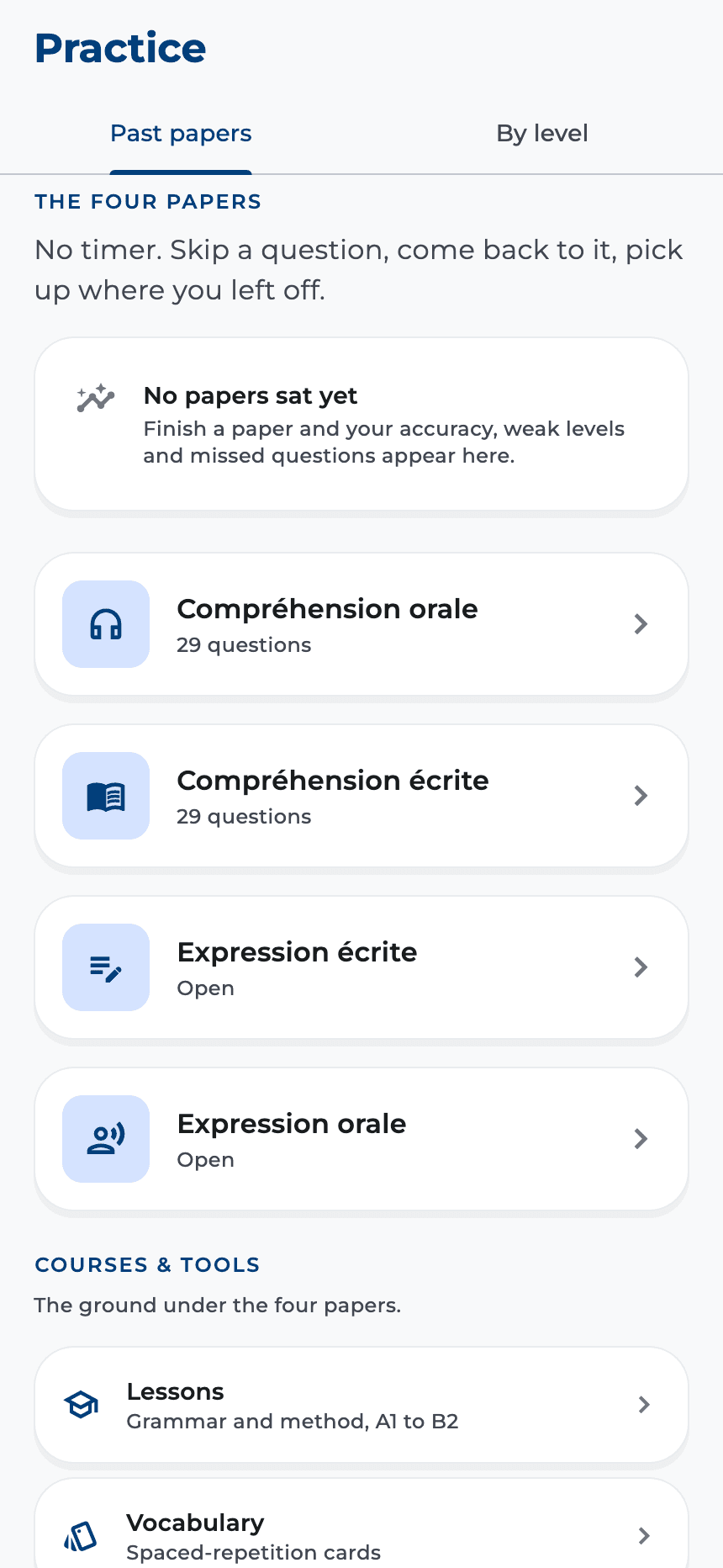
A little practice. A clearer path.
Find your focus in one calm space. Explore the four TCF skills and build confidence, one practice session at a time.
Listening, reading, speaking & writingActual app screens · Sample learning data
No account, no card
What is free, said plainly.
You do not need an account to decide whether this suits you. Here is exactly what you can do right now.
Four complete lessons
Nouns and articles, questions and negation, tenses and duration, spelling traps. Readable in full, without an account.
Read the lessonsTwo reading past papers
The texts, the questions, the right answers and why each option is what it is. Exam conditions, timer included.
Open a past paperThe NCLC calculator
Convert your TCF scores into NCLC levels and see what you still need for Express Entry. Free, always.
Work it outThe four papers
Each paper catches candidates out in its own way.
This is not one French course cut into four. Each section drills its own traps, with its own past papers.
What is inside
Numbers you can check by using it.
Both charts are read straight from the content database. They change when the content changes — downwards too, if that is the truth.
Content by paper
A document is one question with its correction, or one topic with its model answer. The four papers are not stocked in comparable quantities, and the chart does not hide it.
- Listening comprehension1 560 questions
- Reading comprehension1 560 questions
- Written expression1 016 topics
- Spoken expression1 171 topics
See the numbers
| Section | Quantity | Unit |
|---|---|---|
| Listening comprehension | 1 560 | questions |
| Reading comprehension | 1 560 | questions |
| Written expression | 1 016 | topics |
| Spoken expression | 1 171 | topics |
Source: the Lumière content database, read just now.
Questions by level
Most of the content sits at B1–B2, where NCLC 7 is decided — but A1 and C2 are covered, which is not true everywhere.
See the numbers
| Level | Questions |
|---|---|
| A1 | 322 |
| A2 | 486 |
| B1 | 730 |
| B2 | 809 |
| C1 | 482 |
| C2 | 320 |
Source: the Lumière content database. Listening and reading, all levels together.
In total, 5,349 documents of teaching content: past-paper questions with their corrections, writing topics with model answers, and the grammar rules the tutor quotes.
The method
Three steps, in this order.
The biggest waste in TCF preparation is revising what you already know. Everything here is arranged to avoid it.
- One
We find your level
A full past paper under exam conditions. Not a questionnaire about yourself: your level is worked out from your answers, paper by paper.
About 25 minutes
- Two
We work on what is stopping you
Lessons come in the order of your mistakes, not the order of a syllabus. If the subjunctive is costing you marks, it comes first.
15 to 30 minutes a session
- Three
We rehearse until it is dull
Timed papers, a simulated examiner for speaking, corrections on your writing. Exam day should feel like one more rehearsal.
Until your exam date
The difference
Marking is not teaching.
Most preparation platforms tell you what you scored. The useful work starts at the next question: why.
A mark at the end of the test.
Why each option is wrong, on every question.
“Hundreds of questions”, without saying which.
A real count, shown on the home page and verifiable by using it.
Support over WhatsApp, when somebody answers.
A tutor who answers in French at any hour, and human tutors in the app.
You pay before you see the content.
Four lessons, two past papers and the calculator open to everyone, without an account.
A website, and that is all.
The site, the Android app, and a 97,000-entry dictionary that works offline.
The tutor
A question at 11pm, an answer at 11pm.
Not a support bot: a tutor that quotes the rule, gives the example, and warns you about the mirror-image trap. It draws on the same past papers as your exercises.
- Answers in French, with a translation if you ask for one
- Works from a base of rules and past papers, not from memory
- Human tutors too, by message and by call, in the app
An example exchange
Pricing
One price, one period, nothing to cancel.
You pay for the time between now and your exam. No subscription that carries on afterwards.
Common questions
What people ask us before paying.
Do I have to pay to start?
No. Four complete lessons, two reading past papers with their corrections and the NCLC calculator are open without an account and without a card. You only pay if you want what comes after.
What is the difference between the TCF Canada and the TCF Québec?
Both test the same French and are prepared for in the same way. The TCF Canada is used for federal immigration programmes, including Express Entry, where your score is converted into NCLC levels. The TCF Québec is required for Québec procedures. The content here covers both.
What score do I need for NCLC 7?
NCLC 7 requires 458–502 points in listening, 453–498 in reading, and 10 or 11 out of 20 in each of the two expression papers. That is the minimum for the Federal Skilled Worker Program. The calculator here converts your scores both ways and shows what is still missing.
Are the past papers real exam questions?
They are practice items drawn from previous sittings and exercise banks, with the right answer and an explanation of every option. No platform can promise you the questions from your own sitting — anyone who promises that is lying to you.
How does the written expression correction work?
You write in the editor, with the word count the task expects. You get a structured correction — grammar, vocabulary, coherence, following the brief — and a model answer to compare against.
Can I practise on my phone?
Yes. The site works on mobile, and the Android app adds the 97,000-entry offline dictionary, revision reminders and calls with a tutor.
Your exam date is already set. The work starts today.
Start with one lesson and one past paper. If they teach you nothing, you will have paid nothing.